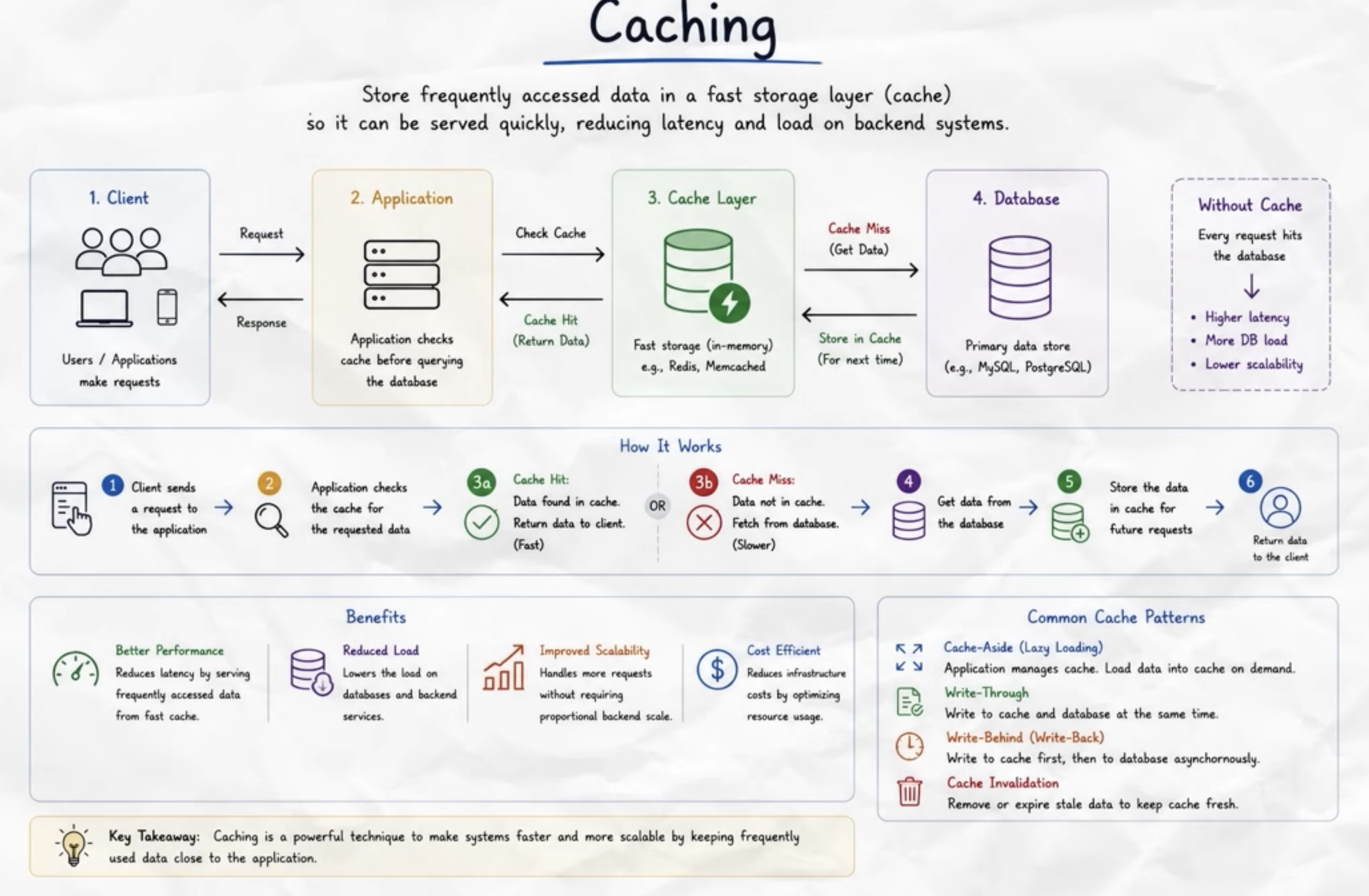
Request flow — click any component
01
Client
Users / apps make requests
→
02
Application
Checks cache before querying DB
→
03
Cache Layer
Redis / Memcached — in-memory fast store
→
04
Database
Primary store — MySQL, PostgreSQL
→
Without cache
Every hit = DB hit
- Higher latency
- More DB load
- Lower scalability
← Select a component to explore it
How it works — the hit/miss decision tree
1
Client requestSends to application
→
2
Check cacheApp looks up key
→
3a
Cache hit ✓Return fast
OR
3b
Cache miss ✗Fetch from DB
→
4
Get from DBPrimary store
→
5
Store in cacheFor next time
→
6
Return dataTo client
← Select a step to explore it
Benefits & cache patterns
Benefits of caching
Better Performance
Serve from memory, not disk
Reduced DB Load
Fewer queries hit the primary store
Improved Scalability
Handle more traffic without DB scale
Cost Efficient
Fewer compute cycles on the DB tier
← Select a benefit to explore it
Common cache patterns
Cache-Aside (Lazy Loading)
App manages cache. Load data on demand.
Write-Through
Write to cache and DB simultaneously.
Write-Behind (Write-Back)
Write cache first, DB asynchronously later.
Cache Invalidation
Remove or expire stale entries.
← Select a pattern to explore it
Key takeaway: Caching is a powerful technique to make systems faster and more scalable by keeping frequently used data close to the application — but the hard problem is cache invalidation: knowing when data is stale and needs to be refreshed.